Hong Kong offers a variety of transportation options, railway travel is the most convenient way. Due to its highly developed railway system, with its dense network and extensive coverage, it remains one of the most frequently used modes of transport for both locals and tourists.
The MTR (Mass Transit Railway) is one of Hong Kong’s railway systems, primarily operating in Hong Kong Island, Kowloon Peninsula, and the New Territories.
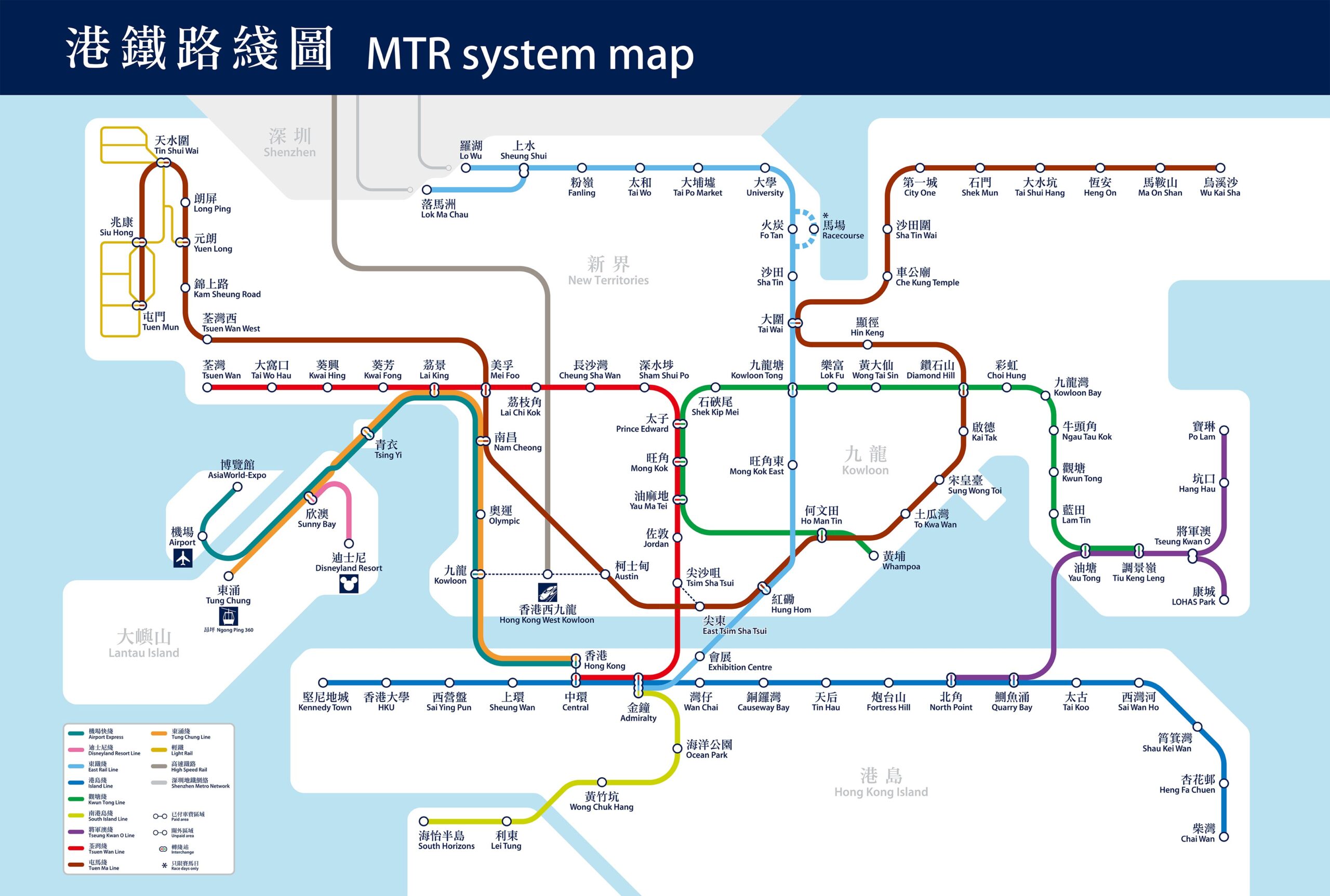
Railway Travel is easy! Just follow the MTR map.
What is the MTR network
The entire subway system includes seven lines. Just follow their respective colored lines to reach your destination. The only thing you need to pay attention to is the transfer stations, such as Prince Edward Station, Mong Kok Station, Admiralty Station, etc.
It also connects to other MTR stations in other areas. The representative colour of the Tsuen Wan Line is red; the Island Line is dark blue. The East Rail Line is light blue, the South Island Line is light green, and the Tung Chung Line is yellow. It is also an early railway system.
Later lines, including the West Rail Line (purple) and the South Island Line (light green), are newer, having joined Hong Kong’s railway system in the last 10-20 years. This is the result of continuous expansion.
The fare for a trip from the New Territories to Hong Kong Island is only HK$15.9 (with Octopus card). However, if the trip involves crossing districts, the fare will be increased accordingly.
For example, taking the MTR from Tung Chung, the furthest point, to Tuen Mun will cost about HK$30.
Tsuen Wan line
The Tsuen Wan Line is one of the major MTR lines and its representative color is red. It was one of the earliest transport plans.
The Hong Kong Government first planned to build the Tuen Wan Line in the 1960s together with the Island Line as the population was growing fast. The Government together with Freeman Fox & Partners, a global consulting company, decided to begin the construction in 1970. Then, it opened to traffic in 1982. It is 16.9 kilometers long and has 16 stations, connecting the New Territories to Central.
There are 9 interchanges along the way, so the Tsuen Wan Line plays an important role in the entire transport network. In fact, the Tsuen Wan Line was built earlier than the Island Line. The Island Line did not officially start operation until 1985, when it ran from Admiralty to Chai Wan.
Therefore, people used the Tsuen Wan Line very frequently, especially by those who needed to travel to Hong Kong Island and the other three major lines later on.
The Island Line
The Island Line is another important route and the third railway line. With continuous expansion, it now has 17 stations. Its representative color is dark blue.
In 1980, the Hong Kong government approved HK$9.5 billion for its construction. It opened in 1985, with the opening ceremony officiated by then-Governor Sir Edward Youde. Initially, it only ran from Admiralty Station to Chai Wan Station.
Over the next 40 years, stations were continuously added, extending from Central to Sheung Wan, and then to Kennedy Town. Actually, the first railway line was just the beginning of the story. This line stretched out like an octopus, followed by the South Island Line, and then extended to Kennedy Town.
Moreover, there are many attractions along the line, from Victoria Peak Station in Admiralty, Statue Square and Tai Kwun in Central Station, to classic British buildings, and various churches. Further, there are several attractions, such as the University of Hong Kong, to Japanese department stores in Causeway Bay, to watching the fire dragon dance in Tai Hang, and the unique old Hong Kong housing estate in Quarry Bay – Monster Building, all of which can be reached on the Island Line.
Whether for convenient transportation, tourism, or economic benefits, the construction costing over HK$40 billion is an achievement for the people of Hong Kong. However, if you’ve noticed, the Island Line was built along the coast, with 16 stations located near the waterfront, except for the last one, Chai Wan Station. Therefore, it’s very convenient for connecting Kowloon across the harbour.
The Light Rail
The Light Rail is a separate system that mainly connects areas in the New Territories. It is usually connected to MTR stations. The Light Rail connects areas without MTR stations.
The Light Rail has a smaller passenger capacity but more stops and travels within the city, similar in function to a tram.
The service area covers the three new towns of Tuen Mun, Yuen Long and Tin Shui Wai, with a total of 68 stations. The Light Rail trains circle around the essential stations in the three districts The Light Rail trains have multiple circular routes, making it one of the important transportation modes in the New Territories.
The East Rail Line
The East Rail Line is an important railway line, represented by the color light blue. It connects the north and south, from Lo Wu and Lok Ma Chau in the north to Admiralty MTR station (including Convention and Exhibition Centre MTR station) in the south, with a total of 16 stations.
This railway has a longer history than the MTR, over 130 years. In its earliest days, it was run by trains, including steam and diesel trains. You can find detailed information from the Hong Kong Railway Museum.
Before merging with the MTR, it was called the Kowloon-Canton Railway (KCRC). They required the passengers to pay fares separately. For example, at Mei Foo Station, you had to enter and exit the gates separately to transfer. It merged with the MTR in 2007. Since then, you no longer need to buy an extra ticket.
The South Island Line
The South Island Line has only 5 stations and its representative color is light green.
It opened in 2016, making it a relatively new construction line. It connects more remote areas such as Wong Chuk Hang and Aberdeen.
Previously, there was no subway; only buses and minibuses connected Central and Wan Chai. The Government decided to build a subway station to connect Aberdeen and Ap Lei Chau. In order to achieve this goal, the contractor, Nishimatsu Construction of Japan, needed to excavate Nam Fung Tunnel.
The MTR is not entirely underground. Some sections are elevated, running on the Aberdeen Channel Bridge and crossing the Aberdeen Strait.
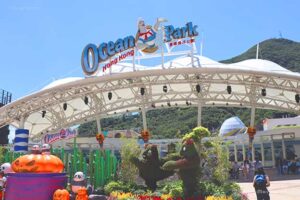
In addition, Ocean Park Station is an elevated station, specially designed for the theme park, although there are also residences, hospitals and schools nearby.
After the construction of this South Island Line, the MTR has covered all 18 districts in Hong Kong. For this reason, railway travel is almost the convenient way to travel and experience this fantastic place.
The Disneyland Resort Line
The Disneyland Resort Line is the shortest railway line, with only two stations, from Sunny Bay Station to Disneyland Resort Station, and its representative color is pink.
This is a railway line specifically designed for Disneyland. As mentioned, this railway is not used by urban commuters, but rather primarily by tourists.
Because these passengers, whether they are tourists entering the park or employees working inside, all have the same goal: to enter the world of Mickey Mouse.
Tung Chung Line
The Tung Chung Line is a railway line connecting Lantau Island, Tsing Yi Island, Tsuen Wan in the New Territories, and Central on Hong Kong Island. It is 31.1 kilometers long. Its representative color is orange.
On the MTR map, it appears to have only eight stations, but it spans four islands. While the map shows a very short distance between Tsing Yi and Tung Chung stations, the travel and waiting time often takes 30 minutes.
The most distinctive feature of the Tung Chung Line is that it’s an airport railway, built specifically for the airport and serving as a vital link in and out of Hong Kong. Planning began in 1998, and it was completed and opened to traffic that same year.
It’s also a crucial stop on the route to Disneyland, with transfers at Sunny Bay Station, Nam Cheong Station near Sham Shui Po, Olympic Station near Prince Edward, Kowloon Station near Jordan, and Hong Kong Station in Central. Therefore, each station is extremely important.
Tseung Kwan O Line
The Tseung Kwan O Line, represented by the color purple, comprises eight stations.
Although relatively short, it connects the eastern new towns and Hong Kong Island and opened in 2002. It is an extension to LOHAS Park Station opened in 2009. LOHAS is an acronym of “Lifestyle Of Health And Sustainability”
This route demonstrates the government’s intention to develop Tseung Kwan O through urban planning. As early as the 1980s, preparations were made to extend the line to Tseung Kwan O and to develop the LOHAS Park residential area.
In addition to developing new towns, it also provides another way to Hong Kong Island. Therefore, they don’t have to go back to Central to cross to the other side of Hong Kong Island. Besides giving passengers another option, it also forms a loop with two tunnels crossing Victoria Harbour. The circulation has become much better and lessened the congestion in Central area.
The Tseung Kwan O Line is also a railway line with two terminus, forming a Y shape. The other end is Po Lam Station. According to online information, Baolin Station opened in 2002 and was built by Maeda Construction Industry Co., Ltd.
The Tseung Kwan O Line was the last MTR line independently constructed by Hong Kong before its merger with the Kowloon-Canton Railway in 2007.
It was a project planned since the 1980s.
At the time, population growth was projected; the new line would only be worthwhile if the new town’s population reached 320,000. Looking back, that decision was correct, as the population today (by 2025) exceeds 410,000.
The English name for Tseung Kwan O used to be Junk Bay, referring to the bay near Lei Yue Mun, not to “General.” It’s a translation of “junk.”
Tseung Kwan O is a relatively suburban area and a newly developed community, so it is particularly attractive to people who enjoy outdoor activities.It has many hiking trails and cycling parks, making it a popular destination for family days.
The Airport Express
The Airport Express is the first railway line that visitors to Hong Kong take. It connects Hong Kong, Kowloon, and the New Territories. Planning began in 1989, and it opened in 1998 with the official opening of Chek Lap Kok International Airport.
In 2005, the AsiaWorld-Expo Station was added, increasing the number of stations to five. The total construction cost was HK$35.1 billion.
The line is 35.3 kilometers long, a considerable distance. Yet, the MTR Corporation claims it takes only about 24 minutes to travel from Hong Kong Airport to Central Station. As a result, it brings significant convenience.
The project was initiated by then-Governor of Hong Kong, David Clive Wilson. It opened in the same year as the Tung Chung Line.
High-speed rail lines
High-speed rail lines are a mode of transportation connecting mainland China and Taiwan. Their representative color is light brown. The Hong Kong-Futian line officially opened in 2018. It was the second cross-border railway after the Kowloon Canton Railway Through Train (KTT), which is now discontinued (in 2020).